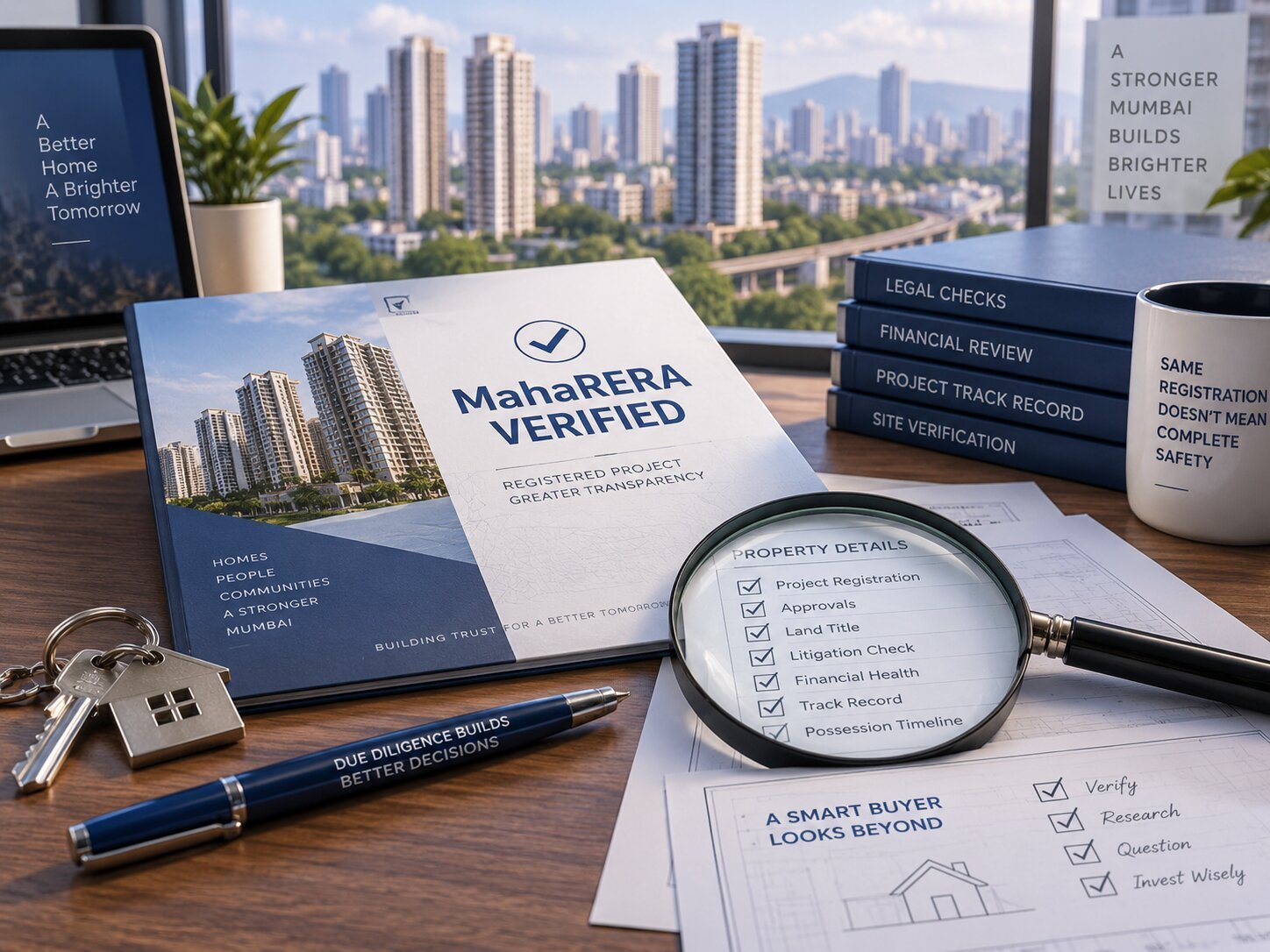
“MahaRERA verified” is printed on almost every property brochure in Mumbai. Ask the average buyer what it actually checks, and most cannot answer beyond “it is registered, so it is safe.” That gap between the badge and what it actually means is exactly where problems slip through. Registration is real protection, but it protects against specific things, and buyers who assume it covers everything are the ones who get caught out.
This guide breaks down what MahaRERA registration genuinely guarantees, what it does not, and how to check a project’s status yourself in a few minutes. It follows on from our guide on the seven documents you must verify before booking any flat, since the RERA certificate is the first of those seven, and the one most buyers misunderstand.
What MahaRERA registration actually is
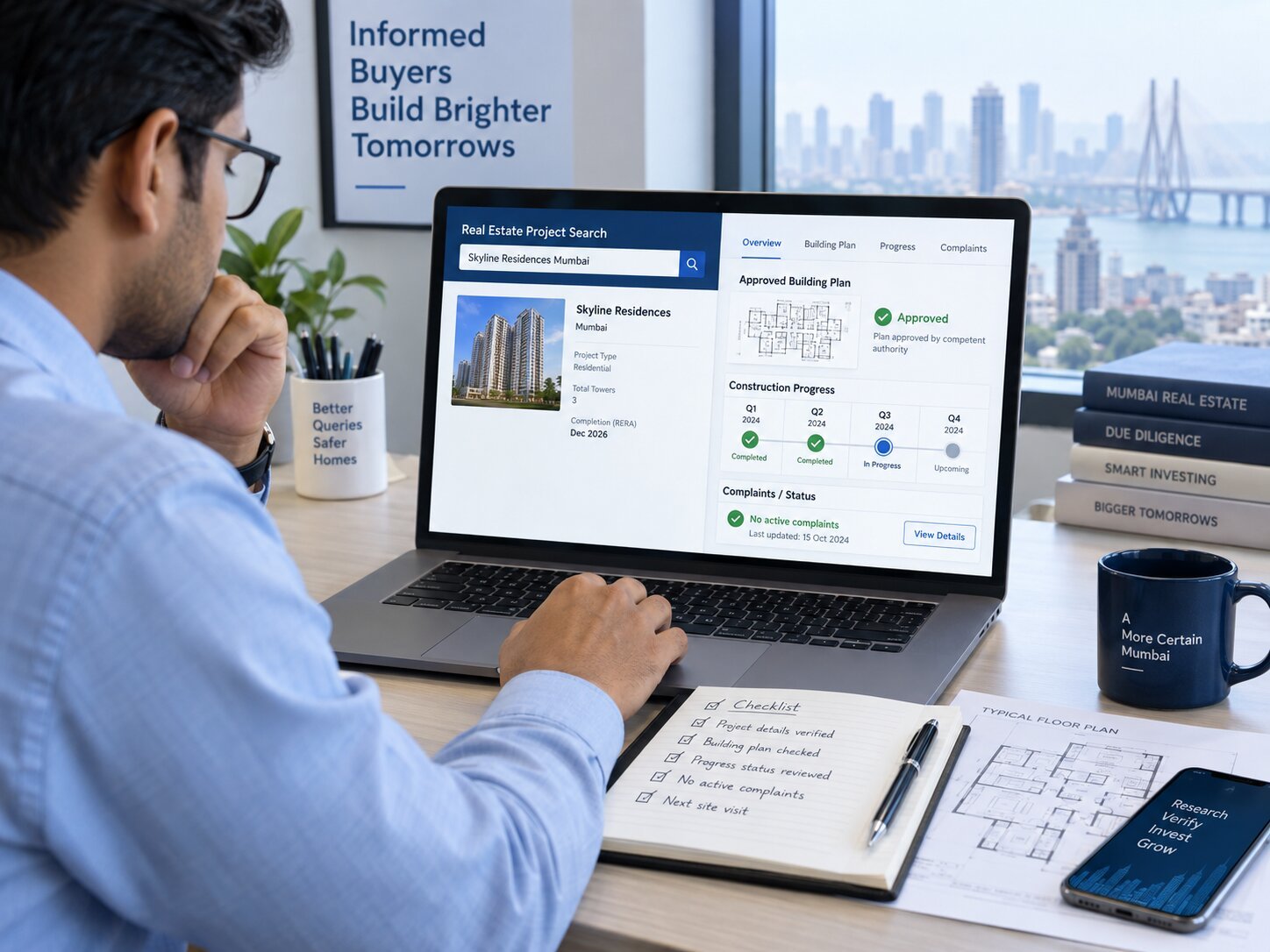
Any residential or commercial project in Maharashtra covering more than 500 square metres, or with more than eight units, must register with MahaRERA before the promoter can advertise, market or accept a single rupee of booking amount. The registration is tied to the Real Estate (Regulation and Development) Act, 2016, and Maharashtra was among the first states to set up its regulatory authority under that law.
Registration is not optional and it is not a marketing add-on a builder chooses to pursue. A project that meets the size threshold and has not registered is, by definition, not legally allowed to sell.
What registration genuinely guarantees
Three protections come directly from registration, and they are real, enforceable ones rather than marketing language.
First, the promoter must deposit at least 70 percent of every amount collected from buyers into a separate escrow account, usable only for the land and construction cost of that specific project. Money cannot be pulled out freely. Each withdrawal has to be certified by an engineer, an architect and a chartered accountant, released roughly in proportion to how much of the project is physically built. This is the single biggest reason RERA exists: it stops a builder from using your booking amount to finish a different, unrelated project.
Second, the promoter must upload quarterly updates to the MahaRERA portal covering physical construction progress, the number of units booked, and any change to the sanctioned building plan. This creates a public, dated record you can check against what the sales team tells you in person.
Third, a builder cannot collect more than 10 percent of the total cost as an advance or application fee before a registered agreement for sale is signed. This caps how much money is at risk before you have a proper legal document in hand.
What registration does not guarantee
This is the part most buyers get wrong, so it is worth stating plainly.
Registration does not certify construction quality. MahaRERA checks that a project is legally compliant and financially monitored, not that the finishing, materials or workmanship meet any particular standard.
Registration does not guarantee the promised possession date will be met. If a builder misses the date declared at registration, RERA gives you the right to a refund with interest, or to continue with compensation for the delay, but it does not stop delays from happening in the first place.
Registration does not mean the project is risk-free. It means specific safeguards exist and specific information is publicly available. Whether the builder is actually a good one to buy from still depends on their track record, which registration alone will not tell you.
| What MahaRERA covers | What it does not cover |
|---|---|
| 70% of your money is ring-fenced for this project only | Construction quality and finishing standards |
| Carpet area is defined and sold accurately, not built-up area | Whether the possession date will actually be met |
| Quarterly, public updates on real construction progress | The builder’s overall reputation or delivery history |
| Pre-agreement advance capped at 10% of the cost | Neighbourhood, resale value or investment return |
| A formal complaint and compensation route if things go wrong | Whether the project is a good fit for your needs |
How to actually check a project’s MahaRERA status yourself
Knowing what the registration means is only useful once you know how to check it, and the process takes a few minutes on the MahaRERA portal.
Search by project name or promoter name
The portal lets you search either way. If you already have the registration number from a brochure or a broker, searching it directly is fastest and confirms the number is genuine rather than invented.
Check the sanctioned layout against what is being sold
The listing shows the approved building plan on file. Compare this against the sample flat or brochure layout you have been shown. A mismatch, even a small one, is worth raising before you book, not after.
Read the quarterly progress reports
This is the section most buyers skip entirely, and it is the most useful one. It shows physical construction progress, updated every quarter, in the promoter’s own submission to the regulator. If a project has been “60 percent complete” for the last three quarterly updates in a row, that tells you more than any sales conversation will.
Check for complaints filed against the project
Any formal complaint filed with MahaRERA against the promoter or project shows on the portal. A clean record is a good sign. A pattern of complaints across a builder’s other projects is worth researching further before you commit to this one.
A mistake worth avoiding
Some buyers treat a broker’s verbal assurance of “yes, it is MahaRERA verified” as equivalent to checking it themselves. It is not. A registration number can be misquoted, outdated, or attached to only part of a larger project, since large developments are sometimes registered in phases with a separate number for each phase.
Always search the number yourself on the portal rather than taking anyone’s word for it, including ours. It takes less time than the sales pitch that usually precedes it.
What to do with this
Before you book anything, get the RERA registration number, search it yourself on the MahaRERA portal, and read at least the most recent quarterly update. If the number does not exist, does not match the project, or the quarterly updates have stalled for several quarters running, treat that as a reason to ask harder questions, not a technicality to overlook.
We verify MahaRERA status, escrow compliance and quarterly progress on every project we present, before it reaches a client. If you want a second set of eyes on a specific project you are already considering in Bhayander, Mira Road or Vasai, we are happy to walk through it with you.